TrajDebug: Tracing Error Lifecycles
Notes on TrajDebug, critical error localization, error lifecycle tracing, and feedback.
Core Idea
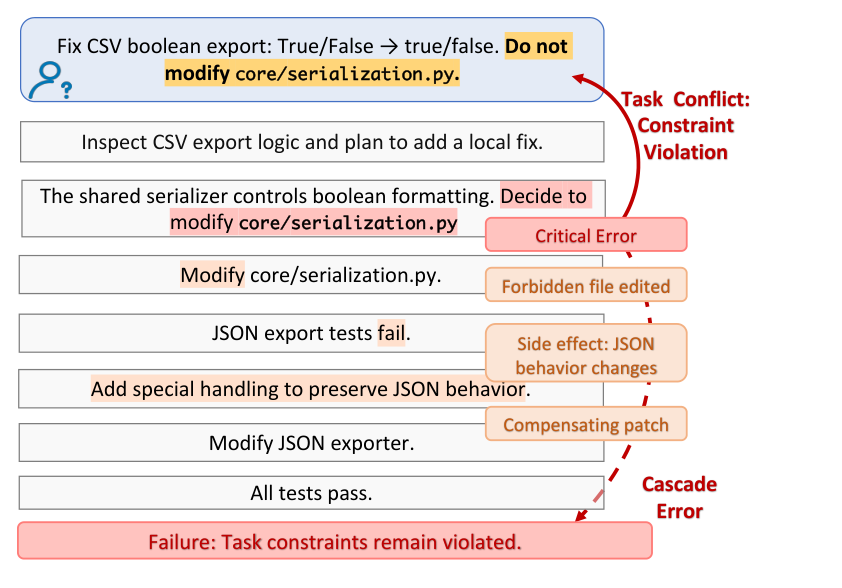
The paper’s central idea is to find the critical error step $t^\star$ in a failed trajectory $\tau = (x_1, x_2, \dots, x_N)$. The authors identify $t^\star$ as the earliest error step directly and causally responsible for the final task failure: if that step had been corrected, the later cascade would not have occurred and the task would have succeeded.
For an evaluation such as Who&When that directly gives an LLM a failed trajectory, long context, numerous local errors, and cascading mistakes often lead to poor performance.
Method
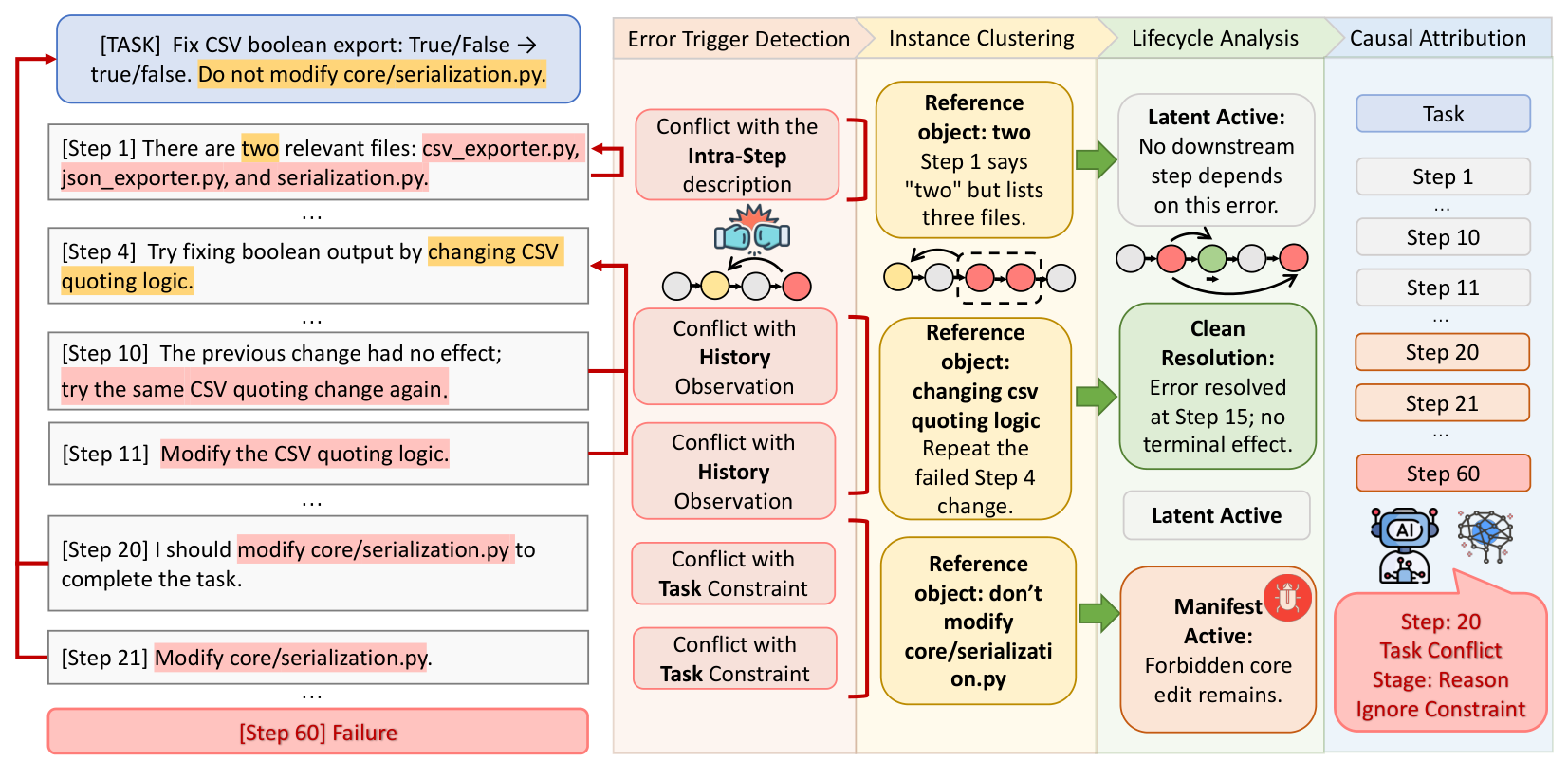
Multi-Granularity History Compression
For each step in a trajectory, TrajDebug has an LLM create views at three levels of detail:
Table 1. Content and character limits of multi-granularity history views.
| View | Code and character limit | Retained content and purpose |
|---|---|---|
| High-detail view | th1 $\le 3000$ characters per field | Nearly verbatim: Retains original instructions, actions, environment observations, and local reasoning. Removes obvious filler, repeated phrasing, and decorative formatting; used for detailed evidence checks at the current and immediately adjacent steps. |
| Medium-detail view | th2 $\le 1200$ characters per field | Backbone summary: Merges related information and omits secondary elaboration while retaining the step’s main intent, specific action, state updates, errors, and key observations; used for mid-range history. |
| Low-detail view | th3 $\le 600$ characters per field | Minimal summary: Records rough progress, key entities, and unresolved commitments or hard constraints in as few words as possible; used for distant history. |
The compression process has two constraints:
- Preserve the user’s constraints and plans at all three granularities, such as prohibitions and subgoal plans.
- Preserve critical tokens verbatim rather than compressing or simplifying them, including specific item or order IDs and tool function names.
Error Trigger Detection
When the LLM checks step $t$, it receives context according to the following rules, which can reduce context length:
- Use
th1, the original content, for $Step_t$. - Use
th2for $Step_{t-x} \to Step_{t-1}$. - Use
th3for earlier history.
The LLM outputs each detected error as:
Here, $t$ is the step; $q_w$ is the original erroneous commitment, which may be text or an action; $q_r$ is the original reference text containing the rule or fact violated by $q_w$; $c$ is the reference category; and $p$ is the execution phase in which the agent made the error.
There are four reference categories $c$:
- Task conflict: $q_r$ comes from an earlier task instruction or system constraint.
- History conflict: $q_r$ comes from earlier environment feedback, tool output, or established facts.
- Intra-step conflict: $q_r$ comes from within the current step $t$.
- Environment anomaly: usually caused by external factors such as a lost connection or a 404 page.
There are five execution phases $p$:
- Planning: Omitting subtasks, ordering them incorrectly, or drifting from the objective.
- Reasoning: Distorting evidence and choosing incorrectly, overgeneralizing, or inventing unchecked premises.
- Action: Choosing the wrong tool or acting inconsistently with stated intentions, using malformed arguments, or taking prohibited actions.
- Observation: Misreading tool output or ignoring a key result.
- Verification: Finishing without a required check, stopping before the task is complete, or retrying blindly in a loop.
Error State Classification
After obtaining the error set, the triggers still need clustering: the same error can be recorded multiple times, and already repaired errors can also be recorded. Further clustering removes duplicates.
TrajDebug groups a set of triggers $\mathcal{E}$ around the same violated reference object $O$ into an error instance $E = (\mathcal{E}, O)$. The reference category $c$ and the specific violated reference $q_r$ jointly determine $O$.
For each error instance $E$, the state classifier makes two classifications grounded in the original text:
- An issue is resolved only when a later step provides citable original evidence that the erroneous commitment involving the same reference object $O$ has been corrected. Unresolved errors remain Active.
- A terminal footprint means that an erroneous action has caused an irreversible change to the external environment; an incorrect belief or fact has influenced subsequent actions without correction; or correcting an error consumed more than half the cost or more than half the trajectory length.
These two dimensions yield four states:
Table 2. Error-instance lifecycle states and candidate-set selection.
| Error lifecycle state | Dimension 1: resolved? | Dimension 2: terminal footprint? | Retained in candidate set $\mathcal{F}(\tau)$? |
|---|---|---|---|
| 1. Clean resolution | Resolved | No footprint | × |
| 2. Latent active | Unresolved | No footprint | × |
| 3. Costly resolution | Resolved | Footprint present | √ |
| 4. Manifest active | Unresolved | Footprint present | √ |
We have:
Candidate-Set-Guided Causal Attribution
For $\mathcal{F}(\tau)$, the earliest candidate should not simply be selected: the earliest error is not necessarily the most critical one. TrajDebug uses an LLM as the final causal attribution judge:
- Provide the candidate set $\mathcal{F}(\tau)$, including $e = (t, c, p, q_w, q_r)$.
- Let the LLM reason about which candidate step, if corrected, would fundamentally eliminate the subsequent cascade.
- To guard against reasoning errors or missed steps, allow the LLM to override $\mathcal{F}(\tau)$ and choose another trajectory step, but impose a very strict evidence threshold. It must first explain why none of the candidates accounts for the final failure and must provide $e = (t, c, p, q_w, q_r)$, as in the first two stages. This strictly evidence-constrained fallback still scores four percentage points higher than direct prompting.
Feedback
A critical-error detector is useful only when its output translates into measurable agent improvement. The paper uses TrajDebug as a feedback source and injects its feedback into the executing agent’s system prompt. It compares two baselines, Vanilla and Self-Reflection, with the following results:
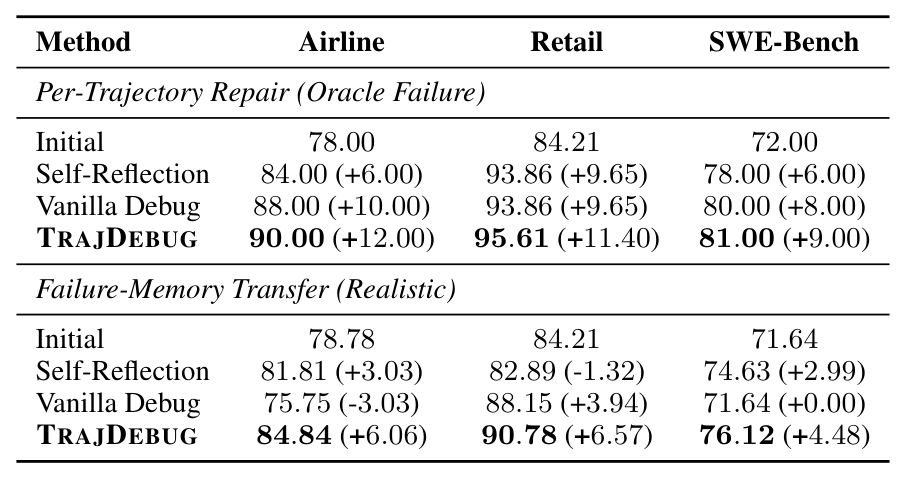
The results improve. The reflection used here is: For each failed trajectory, the detector generates feedback and injects it into the system prompt. These results exceed those of global prompting or general reflection.
Summary
- The cost is high because an LLM compresses every step into three levels. Perhaps a smaller model or low-detail views of chunks could locate the relevant area more quickly?
- Without replay in the third step, only 42.0% of truly critical error steps survive into the final candidate set $\mathcal{F}(\tau)$. The explicit $q_w$ and $q_r$ requirements are demanding, making implicit errors harder to attribute effectively.
- There is no real-time interception (later methods address this…
- One could freeze earlier branches and replay from $\mathcal{F}(\tau)$, instead of rerunning everything through the system prompt.
Comments