DoVer: Intervention-Driven Multi-Agent Debugging
Reading notes on DoVer, multi-agent failure attribution, intervention, and validation.
The Problem
The evaluation approach used by the Who&When (WW) dataset has limitations. Its setup is:
- Input: A complete failed session log, from the user’s question through rounds of interaction among agents to an incorrect final answer or a stopping rule such as the maximum number of replanning rounds.
- Task: Ask an LLM to read the log and identify the earliest, uniquely responsible agent and step that caused the task to fail.
- Decisive error step: A step whose incorrect action could be replaced by a correct one so that the subsequent trajectory succeeds.
The authors found that WW trajectories did not explicitly show step numbers, so the LLM had to track or infer each step. The evaluation criteria given to the LLM also differed from those used in expert annotations. The authors embedded a concise version of the human annotator guidance in the LLM prompt: Find the earliest decisive step that diverted the task and whose correction could lead to success.
After these two changes, GPT-4o’s step attribution accuracy on the WW hand-crafted set with ground truth rose from 6.04% to 23.56%.
WW’s attribution perspective is also narrow. Choosing a single absolute error from multiple errors is inherently uncertain: an LLM’s answer may differ from an expert’s while both identify plausible critical errors. Responsibility between agents can also be ambiguous. A subagent’s error may arise from the subagent itself or from an inadequate task description by the assigning agent; attributing it to only one agent is therefore incomplete.
DoVer
The authors propose DoVer in response. Its central framework can be summarized in three parts:
- Set aside human-annotated ground truth, since failures can be viewed from multiple perspectives, as in MP-Bench. DoVer returns to the definition of a decisive error: directly modify the decision at step $t$ and see whether the subsequent task succeeds. If it does, that step is treated as decisive.
- A long session can contain several ReAct loops, and multiple trials may fail because an LLM may initially explore by trial and error. DoVer separates each trial and looks for failure points within it, shortening context and enabling repair along different failed paths.
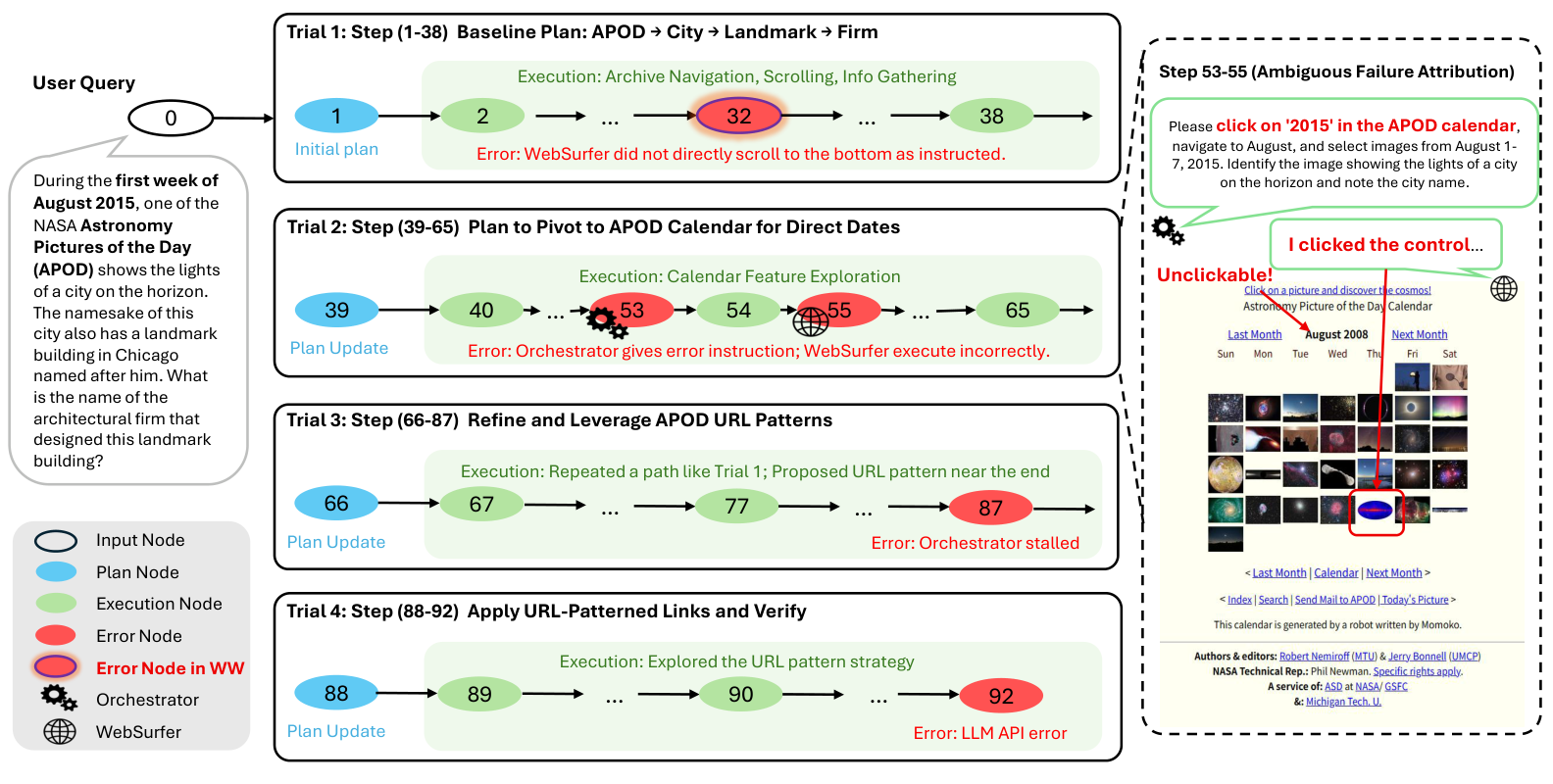
- Responsibility between an orchestrator and subagents is often entangled. DoVer distinguishes two levels of intervention:
- Directly edit the orchestrator’s plan or the prompt sent to a subagent.
- If a subagent cannot complete a task because it lacks a tool, create a new tool to help. This directly modifies the harness and can connect to RSI.
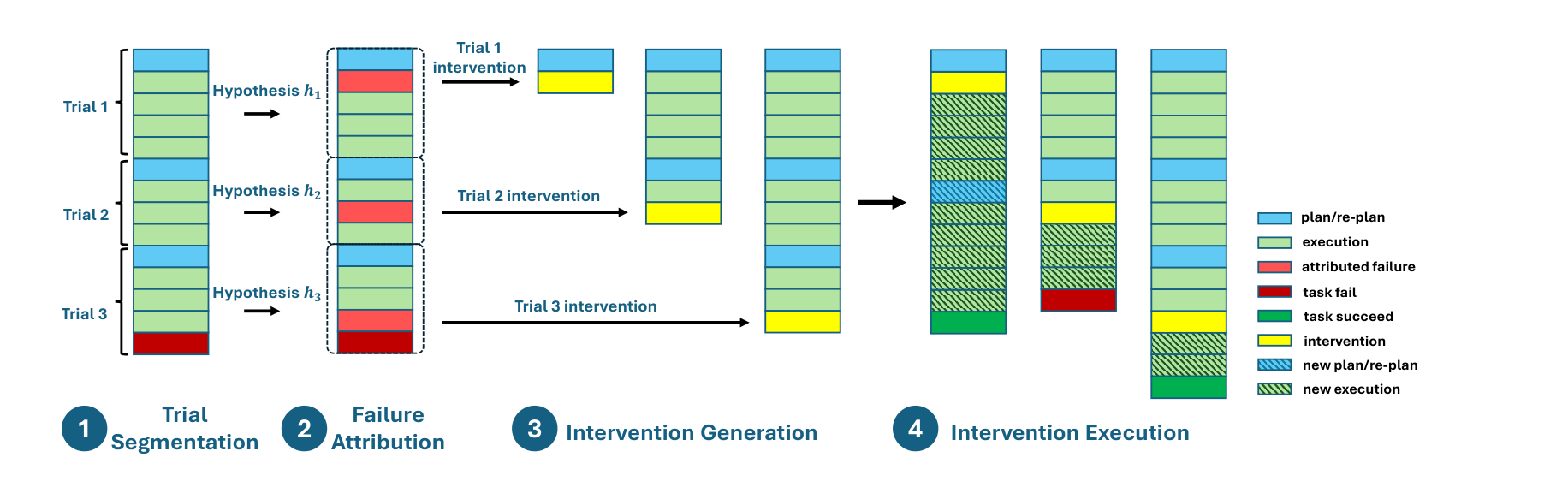
DoVer has four steps:
- Trial segmentation: Split the long failed trajectory $\tau$ into separate trials at self-reflection and replanning steps, shown as blue blocks in Figure 2. This shortens context, supports parallel interventions, and allows multiple repair paths.
- Failure attribution: For a trial $\tau^i$, use an LLM and prompt to generate a candidate hypothesis $h_i = (\hat{a}_{\hat{t}}^i, r_{\hat{t}}^i)$, where $\hat{a}^i$ is the suspected agent and $r_{\hat{t}}^i$ is a natural-language error analysis.
- Intervention generation: Turn $h_i$ into a concrete, minimal text edit $I_i$ for the context at step $\hat{t}$, using one of the two intervention types above.
- Intervention execution: Restore the system snapshot $\sigma_{\hat{t}}$ from before step $\hat{t}$, replace the original erroneous message $m_{\hat{t}}$ with the intervention $I_i$, and continue execution.
Metrics
- Measure the proportion of intervened trial runs that successfully solve the task. For runs that do not succeed, also assess whether the intervention made progress. On datasets with human-annotated solution steps, such as GAIA, an LLM first extracts at most $K \le 5$ tool-agnostic milestones $\{\mathbf{m}^1, \mathbf{m}^2, \dots, \mathbf{m}^K\}$ from the human solution. An LLM judge then counts how many milestones a trajectory $\gamma$ achieves:
Compare the new trajectory after intervention, $\tilde{\tau}_I$, with the original failed trajectory $\tau$:
- To check whether the LLM actually follows $I_i$, the paper also uses an LLM-as-Judge and distinguishes four validation outcomes.
Table 1. Validation outcomes for failure hypotheses after intervention.
| Validation outcome | Criteria, based on three independent reruns |
|---|---|
| 1. Validated | At least two of three reruns fully succeed at the task. |
| 2. Partially validated | Fewer than 2 successful runs, but at least two runs both faithfully follow the intervention and achieve milestone progress of $\ge +20\%$. |
| 3. Refuted | Fewer than 2 successful runs, and at least two runs both faithfully follow the intervention and achieve milestone progress of $\le +20\%$. |
| 4. Inconclusive | Any other case that does not satisfy the first three categories. |
Experiments
Distribution of cases in the paper’s datasets:

Failure-flipping performance:

On WW-AB, which contains many difficult tasks, progress is +0%. On extremely difficult tasks, inappropriate interventions may even interfere with existing progress, so negative progress can offset positive progress.
Validation outcome distribution for failure hypotheses:

On difficult datasets, the framework alone cannot effectively improve performance.
Self-Improvement
These are two future directions the authors anticipate. In the paper, the authors use human collaboration to optimize and add tools, improving agent performance on difficult tasks. I would expect: (i) a fully automated debugging loop, or RSI, where DoVer’s insights feed into automated subagent improvement, for example by using a coding agent to implement repairs; and (ii) capability-aware intervention generation that tailors interventions to known subagent capability boundaries when code changes are not allowed. Both directions can help build robust, self-improving multi-agent systems.
Summary
DoVer offers a shift in paradigm: instead of relying solely on detection and judgment, it uses a suspect–replay–verify process to locate critical error steps. It also points out that, under the ReAct framework, attributing failure to a single action is inherently incomplete. More importantly, DoVer suggests directions for future work, including the ideas discussed in the self-improvement section above.
DoVer still has many limitations. First, its validation and attribution methods cannot readily be applied in real-world settings: the prompts given to the debugging model contain the ground-truth answer, meaning that the judge LLM is looking for errors with the answer already in hand. DoVer also calculates milestone progress using human-written reference steps. In real-world settings, comparable reference answers are not available, which limits practical usability.
- Introduce a PRM in place of the judge LLM with ground truth. Train a PRM specifically to score intermediate steps and trigger unsupervised attribution by detecting logical contradictions, infinite loops, or hallucinations about empty results in trajectories.
- Consider replacing human-written reference steps with a dynamic dependency graph. At the start of a task, a planning and decomposition model could automatically break the user’s original query into a sub-goal directed acyclic graph (Sub-goal DAG) with validation conditions, for example: verify that a data source exists $\rightarrow$ verify field completeness $\rightarrow$ calculate the result. During replay, sub-goal completion could be used directly to calculate Progress Made, removing the dependence on manually annotated steps.
DoVer also has a high token cost: for one failed trajectory, it must open more than four paths for replay. Moreover, for a single trial, one intervention cannot handle compound failures that require multiple corrections along a long chain. Even after correcting an error at step $t$, a later action may contain a new error.
Consider replay in a sandbox simulation environment similar to Dream-RSI.
In addition, DoVer does not ensure that the system will handle an erroneous decision or action correctly next time. When the same situation arises again, there is no framework or reference action to help the LLM correct itself, so it may repeat the error.
This final issue is part of the RSI loop. A persistent memory module might let the LLM retrieve its past errors or a maintained knowledge base during ReAct, helping it correct mistakes. Alternatively, step-level DPO / RL could be used to fine-tune the model, in conjunction with the PRM mentioned above.
DoVer and a coding agent could also co-evolve: the coding agent could assist the decision-making agent and help evolve its tools.
In the WW-AB and WW-GAIA datasets, as many as 57.6%–66.7% of trials ultimately fell into the Inconclusive category. Given model advances, it may be worth evaluating DoVer with modern models to see how they perform.
Comments